

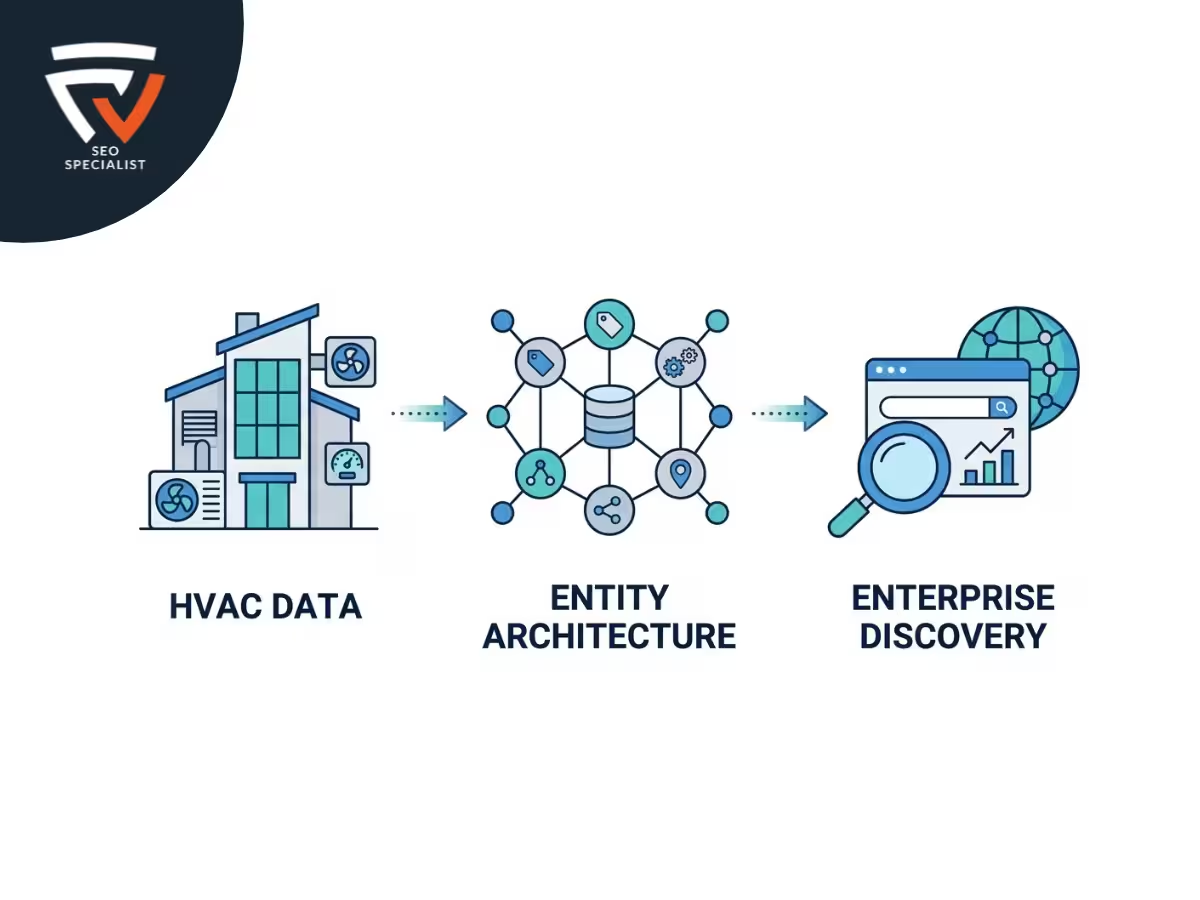
HVAC keywords for SEO are search queries structured around specific heating, cooling, and mechanical system concepts. Modern search engines and generative models no longer treat these terms as isolated text strings. Instead, they process them as interconnected semantic entities—linking equipment models, diagnostic procedures, geographical footprints, and regulatory standards to deliver accurate citations across conversational answer engines.
For enterprise marketing leaders and growth directors across the mechanical and building services sector, traditional search metrics are failing. Keyword planners show impressive monthly search volumes for phrases like “chiller repair near me” or “commercial heat pump installation”, yet targeting those terms with standard blog posts yields shrinking organic pipeline.
The root cause is structural: search engines have shifted from lexical keyword matching to vector-based semantic retrieval. With Google AI Overviews, Perplexity, and conversational AI agents answering basic questions directly in the interface, ranking for a broad keyword no longer guarantees pipeline revenue.
Winning organic inbound demand now requires treating HVAC keywords for SEO not as individual targets, but as nodes within an interconnected semantic entity architecture. By mapping your content to machine-readable knowledge graphs and structuring technical data for Retrieval-Augmented Generation (RAG), your organization can earn direct citations in generative search engines and capture qualified, high-intent prospective customers.
1. The Death of String-Matching: How Semantic Search Redefines HVAC Keywords
Modern search algorithms no longer evaluate how many times a keyword appears on a web page. Instead, natural language processing models convert search terms into dense vector embeddings that map conceptual meaning, intent, and contextual relationships.
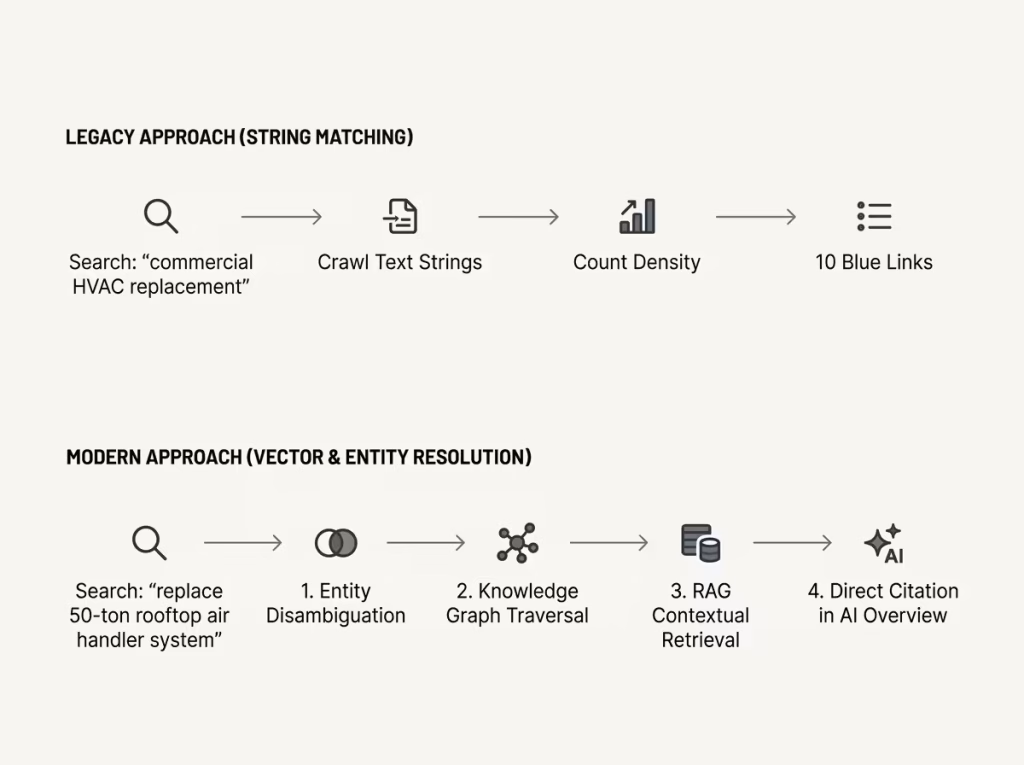
To build a defensible organic footprint, keyword targeting must address three architectural requirements:
- Entity Salience: Search engines calculate how central an entity is to a piece of content. Mentioning “variable refrigerant flow” in a generic list does not signal expertise; demonstrating how VRF systems integrate with specific building management systems (BMS) does.
- Semantic Triples: Search engines parse authoritative data as relational triples: [Subject] -> [Predicate] -> [Object] (for example: [Variable Refrigerant Flow System] -> [requiresRefrigerantPipeSizing] -> [Branch Selector Box]). Content structured around these triples is far easier for AI crawlers to ingest and index accurately.
- Information Gain Scoring: Retrieval systems evaluate incoming content against their existing knowledge bases. If an article merely repeats standard maintenance tips, it receives a low Information Gain Score, causing search engines to omit it from AI summaries and high-ranking positions.
2. The 4-Tier Semantic Taxonomy for Enterprise HVAC Keywords
Organizing search terms into a hierarchical semantic framework ensures comprehensive topic coverage while directly serving different stages of intent.
1. Core Mechanical Entities
These queries identify specific equipment, operating principles, and engineering components:
- Examples: “water-cooled centrifugal chiller”, “modulating gas condensing boiler”, “inverter-driven heat pump”.
- Architectural Role: Defines topic boundaries and establishes foundational domain authority within search knowledge graphs.
2. Diagnostic & Symptom Nodes
High-intent troubleshooting searches used by facility managers and building owners when equipment fails:
- Examples: “chiller high head pressure causes”, “rooftop unit economizer damper stuck”, “cooling tower drift loss calculations”.
- Architectural Role: Captures qualified mid-funnel traffic seeking technical diagnosis before initiating an emergency repair contract.
3. Commercial & Regulatory Intent
Complex queries driven by efficiency standards, regional building codes, and environmental regulations:
- Examples: “ASHRAE 90.1 compliance ventilation”, “low-GWP refrigerant transition timeline”, “commercial building heat decarbonisation retrofit”.
- Architectural Role: Attracts enterprise decision-makers evaluating major capital expenditure (CapEx) replacements.
4. Direct Transactional Dispatch Points
Urgent, geographically-bounded search actions requiring immediate mechanical dispatch:
- Examples: “emergency commercial HVAC repair”, “industrial boiler rental replacement”, “multi-site maintenance contract”.
- Architectural Role: Connects high-intent users directly to telephony routing and live dispatch infrastructure.
3. Step-by-Step Implementation: Building an AEO-Ready HVAC Keyword Cluster
Deploying an enterprise keyword strategy requires translating raw search data into machine-readable digital assets.
Phase 1: Extract Semantic Triples and Form Vector Clusters
Rather than building separate, near-identical pages for “air conditioning maintenance” and “air conditioning tune up”, combine them into a single, comprehensive asset. Build topic clusters that answer the diagnostic question, explain mechanical principles, and detail scheduled service procedures within a unified narrative.
Phase 2: Format for Answer Engine Extraction (RAG)
Generative engines break content into modular chunks to answer user prompts. To make your content easily extractable:
- Place Direct Answer Snapshots of 45–60 words immediately below major headings.
- Use Markdown tables to display engineering specifications, airflow calculations (CFM), and efficiency metrics (SEER2, SCOP).
- Implement diagnostic question-and-answer headings that reflect conversational search queries.
Phase 3: Implement Deep JSON-LD Entity Markup
Reinforce the written content by encoding the underlying entities directly into your page’s code:
- Use the HVACBusiness and Service schema types to identify your business operations.
- Deploy about and mentions properties within JSON-LD to explicitly link concepts on the page to established Knowledge Graph entries (such as Wikipedia or Wikidata URIs for “Refrigeration”, “HVAC”, or “Heat Pump”).
- Define service boundaries using precise GeoShape polygons rather than ambiguous postal code lists.
To see how these architectural disciplines combine to drive qualified organic pipeline, review our specialized enterprise SEO service for a detailed technical breakdown.
4. Strategic Comparison: Legacy Keyword Optimization vs. Modern AEO
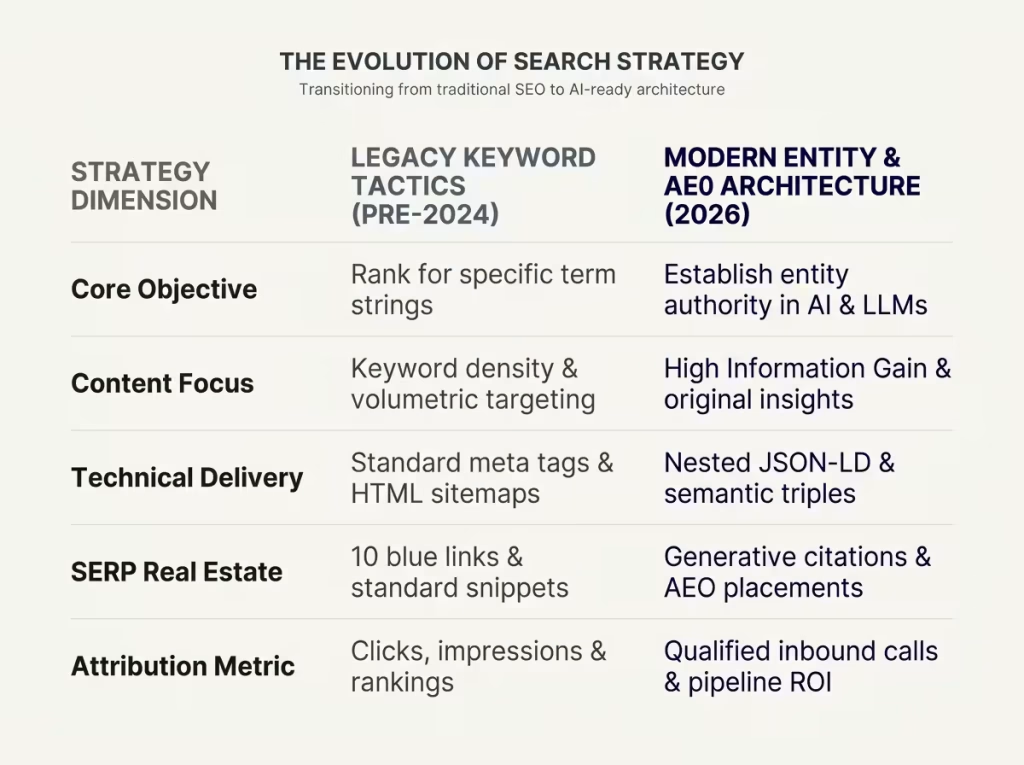
Scaling Enterprise Execution
Managing entity mapping, technical markup, and content architecture across extensive multi-location service footprints demands significant technical bandwidth. Digital marketing agencies managing multi-territory mechanical accounts often scale their capacity by leveraging white-label digital marketing to deliver consistent schema architecture, authoritative link placement, and content production across diverse client portfolios.
5. Frequently Asked Questions
How do HVAC keywords for SEO differ in modern generative search engines?
Modern generative search engines analyze keywords as conceptual entities rather than isolated text strings. Instead of matching simple word repetitions, algorithms evaluate how accurately your content explains mechanical relationships, technical troubleshooting steps, and regulatory standards within a machine-readable knowledge graph.
What is the most effective way to rank for emergency HVAC repair queries?
To rank for emergency repair searches, combine localized HVACBusiness schema markup with immediate click-to-call mobile touchpoints and diagnostic troubleshooting content. Generative search engines highlight service providers that maintain verified local entity signals, consistent operating hours, and rapid direct-dispatch communication channels.
How does Information Gain Score affect HVAC search rankings?
Search engines award high Information Gain Scores to content that provides unique data, technical troubleshooting benchmarks, or original engineering insights not found in other indexed articles. Content that simply restates generic tips receives lower scores and is filtered out of generative answer summaries.
Why is targeting low-volume, technical HVAC keywords valuable?
Technical, low-volume keywords—such as specific error codes or mechanical component failures—typically reflect high-intent searches conducted by facility managers and building owners with an immediate service need. Ranking for these specialized terms delivers higher inquiry-to-appointment conversion rates than broad, high-volume consumer queries.
Transform Your Inbound Acquisition Architecture
Relying on outdated keyword stuffing tactics leaves your business vulnerable to declining visibility across modern answer engines. Sustainable market leadership requires an engineered search ecosystem that builds recognized entity authority, commands direct citations in AI summaries, and routes high-intent prospective customers directly to your dispatch team.
Our team designs enterprise search and Generative Engine Optimization systems for ambitious mechanical and service providers.
Ready to modernize your organic search architecture and build a defensible customer acquisition engine?
- Contact our strategists: Get in touch
- Call our team: +63966337049
- Email our team: contact@fervilvon.com