The cost of HVAC marketing typically ranges between 6% and 12% of gross annual revenue for established residential and commercial contractors, with growth-focused enterprises investing up to 15%. Average customer acquisition costs (CAC) range from $180 to $350 for standard residential maintenance, and from $1,200 to $4,500+ for complex commercial system replacements. Modern performance is maximized when capital shifts from volatile paid auctions into compounding entity-based search architecture.
Growth leads, chief marketing officers, and managing directors operating across enterprise HVAC and mechanical services face a critical financial reality: customer acquisition costs are compounding faster than top-line revenue. Media auctions across global search platforms have become capital-intensive bidding wars, while generative engines like Google AI Overviews, Perplexity, and ChatGPT synthesize user intent at the top of the funnel without passing traffic downstream.
Legacy marketing allocations—spending heavily on pay-per-click clicks, unverified third-party lead brokers, and generic content production—now produce diminishing returns. When the cost to acquire an inbound repair or replacement request outpaces unit economics, marketing ceases to function as a growth asset and becomes an operational liability.
Understanding the true cost of HVAC marketing in modern search landscapes requires looking beyond basic agency fee retainers or platform media spend. It demands a rigorous evaluation of channel yield, programmatic entity visibility, and the structural efficiencies achieved when replacing transient rented media with a permanent, machine-readable organic footprint.
1. Benchmarking the Cost of HVAC Marketing Across Modern Channels
Marketing spend in the HVAC sector is heavily dictated by company scale, service specialisation (emergency residential repairs vs. commercial chillers and retrofit contracts), and territorial competition.
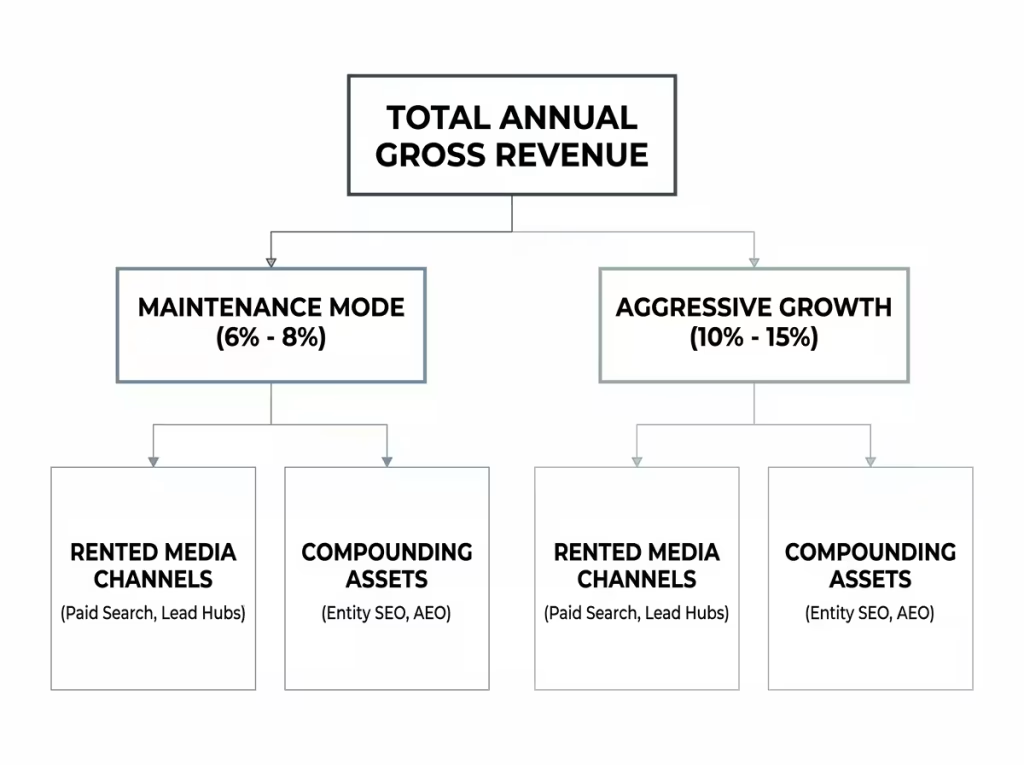
At an enterprise level, industry allocations typically fall into two strategic tiers:
- Market Defence & Maintenance (6% – 8% of Gross Revenue): Deployed by established mechanical contractors operating at field capacity, focused on customer retention, commercial maintenance contracts, and defensive brand capture.
- Aggressive Footprint Expansion (10% – 15% of Gross Revenue): Deployed by multi-territory groups, fast-scaling franchises, and enterprises entering competitive new metro areas to establish primary brand presence.
Channel Cost & Efficiency Analysis
| Marketing Vector | Typical Monthly Spend Range | Immediate Lead Velocity | Long-Term Compounding Asset? | Cost-Per-Acquisition (CAC) Profile |
| Paid Search (PPC / Local Service Ads) | $5,000 – $35,000+ | Immediate | No (Ceases when funding stops) | Volatile; rises directly with competitor bidding wars |
| Shared Lead Networks | $2,500 – $10,000 | Immediate | No (Data is shared with 3–5 competitors) | High blended cost due to low close rates (8%–15%) |
| Traditional Agency Retainers | $3,500 – $8,000 | Slow (3–6 months) | Minimal (Focuses on outdated keyword counts) | Medium to high; fails to capture AI answer engine queries |
| Enterprise AEO & Entity Architecture | $4,500 – $12,000 | Medium (2–4 months) | Yes (Builds permanent Knowledge Graph equity) | Predictable; lowers marginal lead costs over time |
2. The Hidden Cost Drivers Compressing HVAC Margins
When marketing directors audit low conversion performance, the issue is rarely top-of-funnel traffic volume. The margin erosion stems from structural inefficiencies across the customer acquisition journey:
1. The Speed-to-Lead Fallacy and Shared Lead Friction
Purchasing low-cost lead forms often seems cost-effective on a budget spreadsheet. However, because those inquiries are broadcast concurrently to multiple competitors, contact rates drop precipitously if follow-up does not occur within 120 seconds. Paying staff to chase unresponsive consumers inflates the blended acquisition cost far beyond the initial form purchase price.
2. Search Engine Zero-Click Extraction
Modern search engines do not merely present ten blue links; they resolve urgent user problems directly in the interface. When an air-conditioning system fails during a heatwave, users read synthesized troubleshooting overviews and click verified direct-dispatch contact numbers. If your web assets lack structured data and high Information Gain Scores, your brand is omitted from algorithmic citations, leaving you dependent on high-cost paid ads for visibility.
3. Disconnected Attribution and Telephone Intake Breakdowns
HVAC services are fundamentally driven by voice calls. Relying on basic session web analytics without Dynamic Number Insertion (DNI) or integrated dispatch tracking creates attribution blind spots. When dispatchers fail to convert inbound emergency calls into scheduled truck rollouts, media spend is wasted regardless of channel quality.
3. Structural Reallocation: Moving from Rented Media to Knowledge Graph Equity
To lower customer acquisition costs sustainably, enterprise leaders must pivot their capital strategy. Rather than allocating 85% of budgets to paid search auctions that reset every month, forward-thinking organizations invest in modern technical infrastructure, machine-readable schemas, and Generative Engine Optimization (GEO).
The Architectural Components of Modern AEO:
- Deep Semantic Schema Implementation: Moving beyond generic schema code to structured JSON-LD entities that link physical facilities, verified technician credentials, service radius polygons, and specific equipment models (e.g., heat pumps, variable refrigerant systems).
- Information Gain Content Assets: Creating technical diagnostic manuals, equipment efficiency comparisons (SEER2/COP ratings), and total-cost-of-ownership analyses that search engine retrieval systems cite as authoritative sources.
- Knowledge Graph Disambiguation: Aligning business directory profiles, business registrations, patents, and technical accreditations to anchor your brand as a recognized entity in machine learning databases.
For enterprise teams evaluating how to structure these systems to reduce their blended customer acquisition costs, our dedicated specialized SEO service provides the deep technical audits, entity mapping, and scalable content architecture necessary to drive consistent inbound pipeline.
4. Execution Matrix: Legacy SEO Retainers vs. Modern AEO Infrastructure
When evaluating agency partnerships and internal investments, growth leads can use this framework to verify if their marketing budget addresses 2026 search realities:
Scaling Enterprise Delivery with White-Label Infrastructure
For growing marketing agencies handling commercial HVAC accounts, building in-house teams of specialized entity engineers, schema architects, and technical analysts across every regional client can stretch operational margins.
Many high-growth agencies address this operational bottleneck by partnering with dedicated white-label digital marketing infrastructure providers. This allows client-facing teams to deliver enterprise-grade semantic mapping, high-authority link acquisitions, and technical execution seamlessly under their own brand banner while preserving operational efficiency.
5. Frequently Asked Questions
What is the average customer acquisition cost (CAC) for an HVAC installation?
Across enterprise benchmarks, acquiring a residential HVAC system replacement through paid search or shared aggregator leads ranges from $250 to $600 per closed job, while commercial replacement CAC can exceed $2,500. Establishing organic entity visibility and AI answer engine placement reduces these acquisition figures by 35% to 50% over a 12-month period.
How much should an HVAC business allocate to organic search vs. paid ads?
Mature HVAC organizations should allocate roughly 40% to 50% of their digital marketing budget to paid search and performance call routing for immediate demand capture, while directing 50% to 60% into owned entity architecture, AEO, and technical content systems. This balance ensures immediate pipeline flow while steadily lowering long-term reliance on paid auctions.
Why are paid search clicks becoming more expensive for HVAC companies?
Paid search costs rise because auction formats match local providers against aggressive national aggregators and private-equity-backed regional operators bidding on identical keywords. This competitive bidding creates an unsustainable cost-per-click escalation that directly compresses gross operating margins.
How does Generative Engine Optimization reduce long-term marketing expenses?
GEO structures your brand’s digital assets so answer engines (like ChatGPT and Google AI Overviews) recognize your business as a verified local authority. By earning direct inclusion in conversational summaries and automated voice results, you generate high-intent inbound calls and project inquiries without paying per-click media fees.
Audit Your Marketing Spend and Protect Your Margins
Continuing to funnel marketing budgets into volatile search auctions and low-intent shared forms leaves your operating margins exposed to diminishing returns. Building a sustainable, market-leading enterprise requires an engineered organic growth engine that builds lasting brand equity and lowers acquisition costs over time.
Our team develops advanced entity search systems and answer engine architectures for performance-focused service enterprises.
Ready to modernize your marketing economics and secure durable organic visibility?
- Book an Inbound Growth Strategy Call: Contact our team
- Direct Line: +63966337049
- Direct Email: contact@fervilvon.com