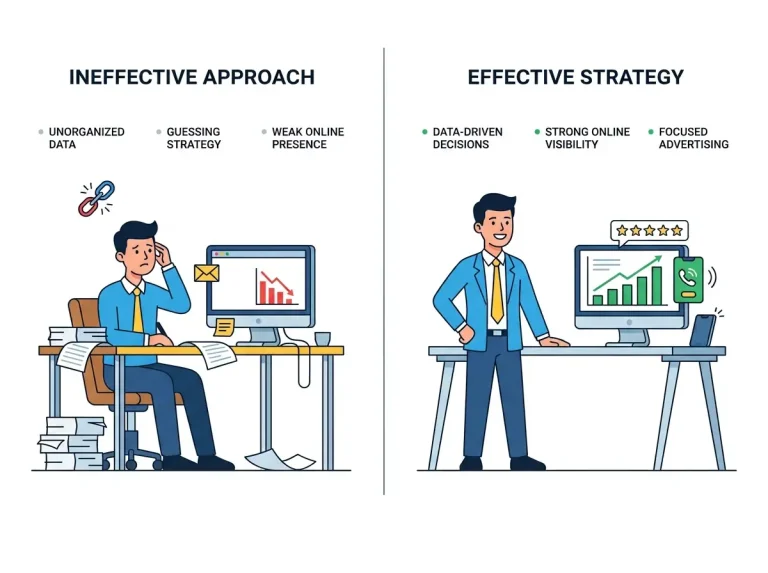
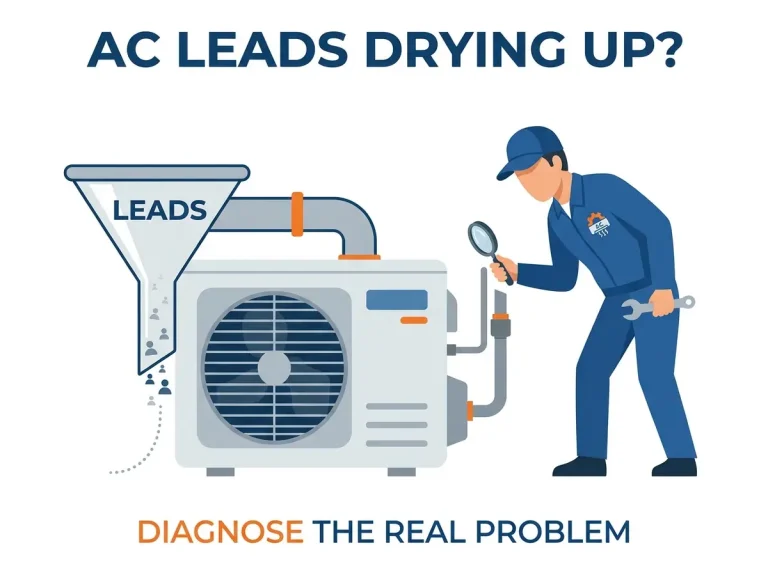
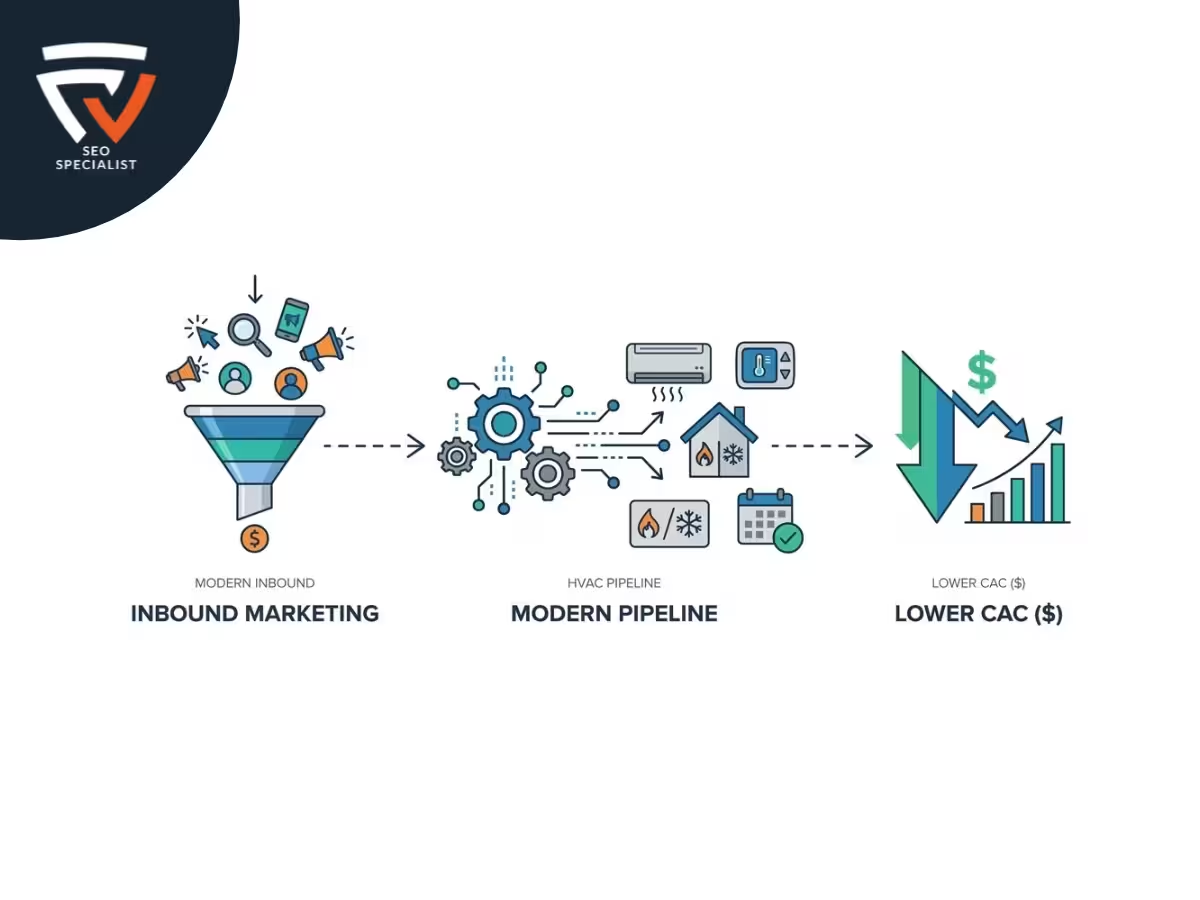
HVAC advertising encompasses the strategic deployment of paid digital media, local service auctions, and organic answer engine optimization (AEO) to capture commercial and residential mechanical service demand. In modern search landscapes, defensible advertising requires unifying performance telephony with machine-readable entity schemas, establishing verified Knowledge Graph authority, and deploying high-information-gain content that conversational AI engines directly cite.
Across the global mechanical and facility services sector, marketing leadership faces a compounding unit-economics crisis: paid ad auctions have turned into zero-sum capital burn competitions. Bidding on commercial installation terms and emergency repair keywords pits enterprise providers against private-equity rollups and national lead aggregators, driving cost-per-click rates to unprecedented highs. Simultaneously, generative engines—including Google AI Overviews, Perplexity, and conversational voice interfaces—resolve urgent user queries directly in search results, starving unoptimized digital assets of organic click-through volume.
For B2B founders, CMOs, and enterprise marketing directors managing commercial mechanical fleets and multi-territory operations, legacy playbooks are failing. Rented traffic channels deliver volatile margins, while shared lead directories broadcast low-intent consumer forms to four competitors at once.
Sustainable pipeline growth requires treating HVAC advertising not as disconnected media buys, but as an engineered inbound demand architecture. By combining high-efficiency media allocation with machine-readable entity data, Retrieval-Augmented Generation (RAG) content structures, and closed-loop telephony routing, enterprise operators can escape the auction price trap and build a defensible, compounding acquisition engine.
1. Tangible Business Impact: Pipeline Expansion, Lower CAC, and Organic Defensibility
Evaluating advertising performance solely through top-of-funnel impression metrics or raw click counts obscures operational profitability. For enterprise operators, the value of modern advertising architecture is reflected in bottom-line unit economics:
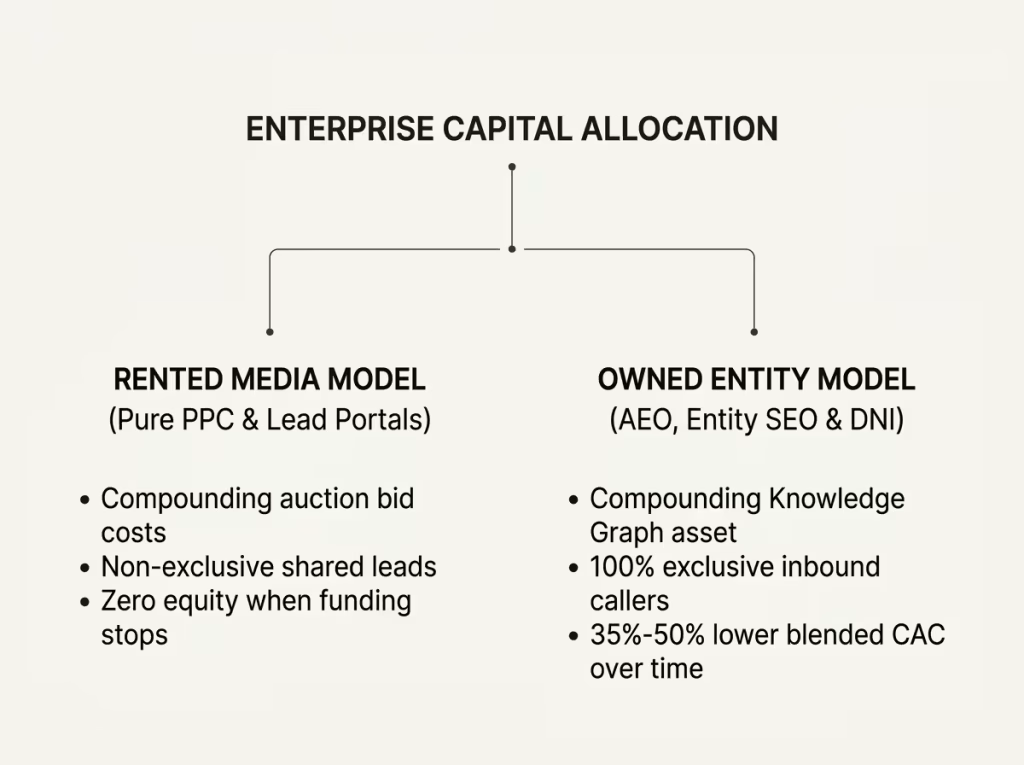
Key Financial Benchmarks of Architectural Advertising
- Blended Customer Acquisition Cost (CAC) Reduction: By establishing verified entity authority within search knowledge graphs, high-intent generative discovery channels capture organic citations, lowering enterprise blended CAC by 35% to 50% within 12 months.
- 100% Lead Exclusivity: Unlike lead brokers that sell a single equipment replacement enquiry to multiple contractors, owned advertising and AEO infrastructure delivers exclusive, direct-dispatch telephone calls and qualified commercial RFPs.
- Algorithmic Defensibility: Companies with deeply integrated entity schemas and verified corporate credentials (hasCredential, licensed master technicians, and localized geographic polygons) remain protected against core algorithm volatility, retaining primary AI synthesis citations across global search engines.
2. Channel Dynamics: Paid Ad Auctions vs. Owned Entity Inbound Systems
Optimizing capital deployment requires auditing the operational trade-offs across core customer acquisition channels:
| Performance Attribute | Paid Search & Display Auctions | Shared Aggregator Portals | Traditional Agency SEO | Enterprise AEO & Entity Systems |
| Immediate Inbound Velocity | Immediate | Immediate | Slow (4–6 months) | Accelerated (2–3 months) |
| Lead Exclusivity | 100% Exclusive | Non-exclusive (3–5 vendors) | 100% Exclusive | 100% Exclusive |
| Average Conversion to Close | 14% – 22% | 8% – 14% | 16% – 26% | 36% – 54% |
| AI Answer Engine Extraction | Vulnerable to ad blindness | Bypassed by answer engines | Ineffective | Primary citation source |
| Long-Term Balance Sheet Equity | Zero (Ceases when spend ends) | Zero (Permanent reliance) | Minimal | High (Compounding knowledge graph presence) |
3. The 4-Pillar Generative Advertising & Entity Framework
To capture multi-site commercial retrofit contracts, industrial equipment servicing, and high-margin residential replacements, our approach integrates paid media mechanics directly into an owned organic architecture.
Pillar 1: Advanced Semantic Entity Schema
Generative models do not interpret brands as strings of keywords; they map them as authoritative nodes in a global Knowledge Graph.
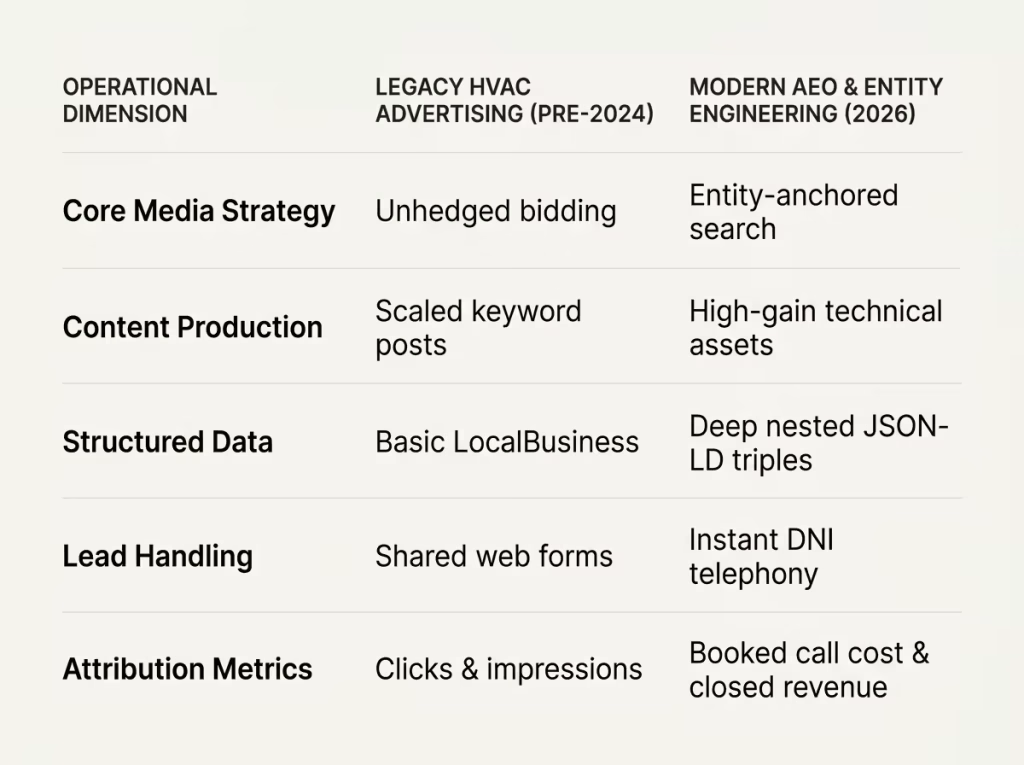
- Deploy nested HVACBusiness, Service, and Organization JSON-LD schemas connected via canonical @id URIs.
- Define service territories using precise GeoJSON coordinates and bounded service polygons rather than ambiguous postal code text.
- Explicitly encode technician accreditations, regional compliance licenses, and manufacturer certifications using hasCredential schema properties to feed search engine algorithmic trust scores.
Pillar 2: High Information-Gain Content Architecture
Modern retrieval algorithms evaluate web content against existing training sets. Pages that merely repeat basic maintenance advice receive a low Information Gain Score and are suppressed in generative summaries. We deploy:
- Engineering Diagnostic Schematics: Precise technical workflows addressing variable refrigerant flow (VRF) errors, head pressure irregularities, and compressor diagnostics that AI engines can extract as multi-part solutions.
- Empirical Total Cost of Ownership (TCO) Models: Data-rich frameworks analyzing the financial trade-offs between legacy refrigerants and low-GWP transitions across commercial facilities.
Pillar 3: Retrieval-Augmented Generation (RAG) Formatting
Generative engines ingest digital assets in modular chunks. To maximize direct citation in AI Overviews and answer engine summaries:
- Embed concise, 45-to-60-word Direct Answer Snapshots immediately below major structural headings.
- Organize equipment specifications, seasonal energy efficiency ratios (SEER2, SCOP), and airflow metrics (CFM) into clean, semantic Markdown tables.
- Structure service sections around diagnostic questions that mirror natural conversational voice inquiries.
Pillar 4: Telephony Conversion and Closed-Loop Attribution
High-value HVAC contracts and emergency repair calls originate via voice. An enterprise acquisition engine must bridge digital touchpoints with live dispatch operations:
- Implement Dynamic Number Insertion (DNI) across all landing pages to track inbound calls back to the specific entity node or ad asset that generated the session.
- Configure programmatic IVR call flows to route commercial emergency requests directly to senior dispatchers, preventing call abandonment.
- For enterprise organizations seeking to build out this multi-layered framework, leveraging an end-to-end specialized SEO service provides the structured technical foundation, entity mapping, and ongoing authority building required to scale organic pipeline reliably.
4. Operational Playbook: Legacy HVAC Advertising vs. Modern AEO Architecture
Strategic Scalability for Digital Agencies
For digital marketing agencies managing mechanical contractor portfolios, handling complex entity mapping, schema engineering, and technical backlink acquisition in-house can stretch operational margins.
Leading digital agencies overcome this operational hurdle by partnering with white-label digital marketing infrastructure providers. This partnership enables client-facing teams to deploy enterprise-grade semantic schemas, high-authority backlink acquisitions, and technical content workflows under their own brand banner while maintaining healthy operating margins.
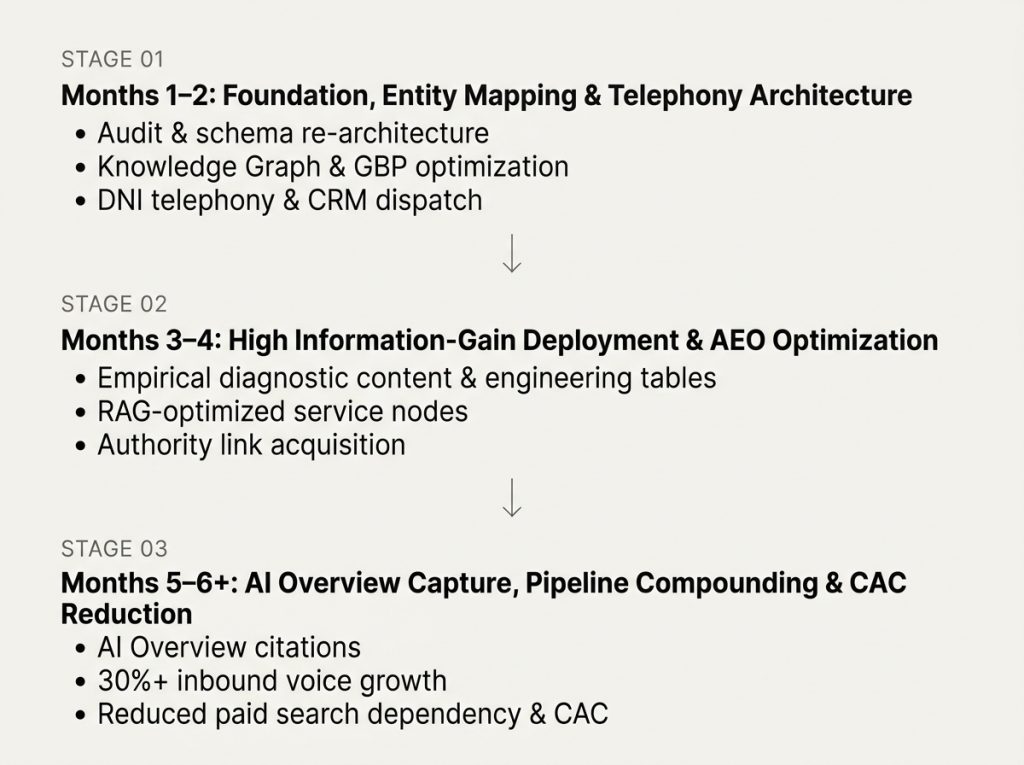
5. Measurable ROI Milestones and Deployment Timelines
Transitioning from an ad-spend-dependent acquisition model to a compounding inbound entity engine occurs over structured operational stages:
6. Frequently Asked Questions
How does modern AEO integrate with paid HVAC advertising?
AEO complements paid advertising by capturing high-intent organic discovery in AI search engines (like Google AI Overviews and Perplexity). While paid advertising provides rapid market testing, an optimized entity architecture establishes compounding Knowledge Graph authority, reducing overall paid ad dependency and lowering your long-term blended customer acquisition cost.
Why is Dynamic Number Insertion (DNI) essential for HVAC advertising?
DNI uses client-side JavaScript to display unique telephone numbers to individual visitors, tracking each call back to its exact keyword, landing page, or AI search referral. This telemetry feeds directly into enterprise dispatch CRMs, allowing marketing leaders to evaluate campaigns based on booked service revenue rather than superficial web clicks.
How does Information Gain Score affect HVAC advertising efficiency?
Search engines award high Information Gain Scores to digital assets that deliver novel data, proprietary diagnostic workflows, or empirical mechanical benchmarks not found elsewhere in their index. High-gain content earns preferred placement in generative answer summaries, capturing high-intent inquiries without ongoing media spend.
What causes customer acquisition costs (CAC) to rise in traditional HVAC advertising?
CAC rises because auction-based ad platforms force local and regional contractors to bid directly against national lead aggregators and venture-funded operators on the same keywords. When combined with zero-click AI summaries that capture top-of-funnel clicks, companies relying purely on paid ads experience continuous margin compression.
Modernize Your Inbound Acquisition Infrastructure
Continuing to pour capital into volatile ad auctions and unverified shared lead brokers exposes your operating margins to diminishing returns. Building a sustainable, high-margin mechanical enterprise requires an engineered customer acquisition architecture—one that establishes authoritative entity presence, captures direct AI answer citations, and routes high-intent prospective clients straight to your dispatch line.
Our strategists build advanced entity search architectures, AEO systems, and scalable inbound engines for forward-thinking mechanical service enterprises.
Ready to modernize your digital customer acquisition and protect your operating margins?
- Book an Inbound Growth Strategy Call: Contact our team
- Direct Line: +63966337049
- Direct Email: contact@fervilvon.com