Table of Contents
“Content SEO helps HVAC businesses improve Google rankings by creating useful, relevant content that matches customer search intent, targets local services, and turns search visibility into qualified leads.”
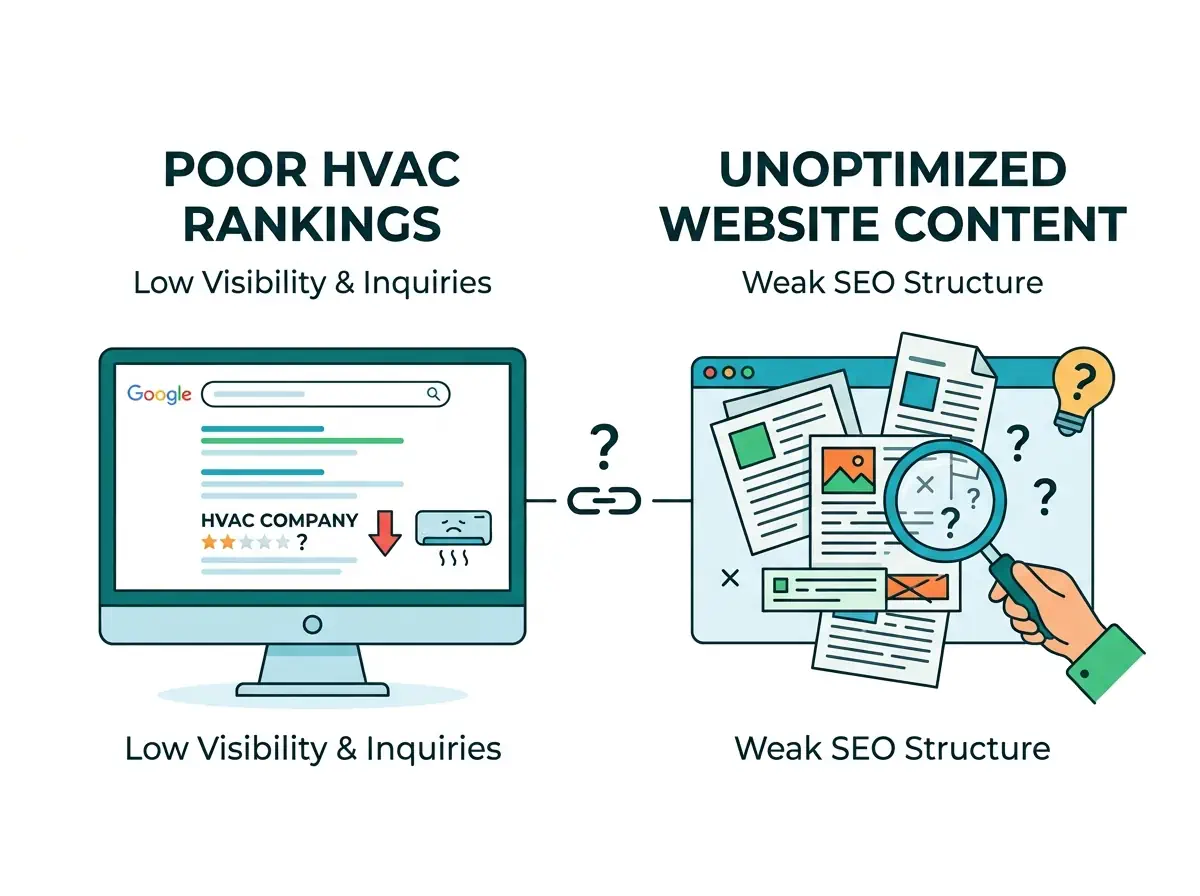
Content SEO can help HVAC businesses improve poor Google rankings and reach more Australian customers. If your website is not ranking for key searches, weak or unclear content may be the problem.
Many HVAC websites have thin service pages, general blog posts, or content focused too much on keywords. A better approach is to create useful, clear content that matches what customers search for.
Google also recommends helpful, reliable, people-first content instead of content made only to rank.
What Is Content SEO?
Content SEO is the process of creating and improving website content to help it appear in search results and provide value to visitors.
It goes beyond adding a keyword to a page. A good content SEO strategy looks at:
- What people search for
- Why they search
- What questions they have
- Which services they need
- Where they are located
- What information helps them make a decision
Searches like air conditioning repair Sydney, ducted air conditioning Melbourne, and HVAC maintenance Brisbane can guide your content strategy.
Don’t repeat keywords just to rank. Create useful pages that match what people are searching for.
Fervil Von uses content SEO to combine keyword research, helpful content, search intent, and lead generation.
Why Is Your HVAC Website Not Ranking?
Poor rankings can come from technical issues, strong competition, weak links, poor site structure, or weak local signals. But your content may also be holding you back.
Here are common content problems to check:
Your Service Pages Are Too Thin
Putting all HVAC services on one page is a common mistake.
A single “HVAC Services” page may list repairs, heating, installation, and maintenance without giving enough detail.
Create a separate, useful page for each main service. This helps Google understand your services and helps customers find the right solution.
Instead, create a separate, useful page for each major service.
For example:
- Air conditioning repair
- Air conditioning installation
- Split system installation
- Ducted air conditioning
- HVAC maintenance
- Heating repair
- Commercial HVAC services
Each page should explain the service clearly. Include common problems, who needs the service, what the process involves, service areas, and why customers may need professional help.
Do not make a page longer just to reach a word count. Google says there is no preferred word count for search rankings. The content should be as detailed as needed to satisfy the search.
Your Content Does Not Match Search Intent
Search intent is the reason behind a search.
Consider these two searches:
- “How often should I service my air conditioner?”
This is mainly informational. The person wants an answer.
- “Air conditioner repair Sydney”
This has stronger service intent. The person may be looking for a business to contact.
These searches need different types of content.
For HVAC agencies, your content should cover both informational and service-based searches.
Informational content can answer questions such as:
- How often should an air conditioner be serviced?
- Why is my air conditioner not cooling?
- How long does a split system last?
- What are the signs of HVAC problems?
- How can I improve air conditioner efficiency?
Service pages can target searches such as:
- Air conditioning repair Sydney
- HVAC services Melbourne
- Ducted air conditioning Brisbane
- Commercial HVAC Perth
When your content matches search intent, it becomes more useful to the person searching.
Your HVAC Content May Be Too General
Broad topics may bring traffic, but not the right customers.
For example, “How to Save Energy at Home” is too broad. Try “How to Reduce Air Conditioning Costs During an Australian Summer” instead.
Focus on real HVAC questions, share useful advice, and show your expertise. Your content should help readers understand their problem and know what to do next.
Your Website Lacks Local Content
HVAC is a local service.
Customers usually want a company that can serve their home or business in their area. That makes local relevance important for Australian HVAC websites.
For example, an HVAC business serving Melbourne could create a useful page for air conditioning repair in Melbourne.
The page could explain:
- Common air conditioning problems
- Types of systems the company repairs
- When to call a professional
- Areas covered
- What customers can expect
- How to request a service
However, avoid creating dozens of pages that are almost identical except for the suburb name.
Every local page should offer real value.
Google also provides tools for businesses to manage their service areas and business information through their Business Profile.
Stop Stuffing Keywords Into Your Content
Adding the same keyword many times will not automatically improve rankings. It can also make your content difficult to read.
For example:
“Our Sydney air conditioning repair team provides Sydney air conditioning repair for customers who need Sydney air conditioning repair.”
That sounds unnatural. Instead, use the main keyword naturally and include related terms when they make sense.
For example, a page about air conditioning repair may naturally discuss:
- Air conditioner repairs
- Cooling problems
- Split system repairs
- AC maintenance
- Air conditioning technicians
- HVAC services
Write for people first.
Google’s guidance focuses on helpful content created to serve users rather than content made mainly to manipulate search rankings.
How Content SEO Can Improve HVAC Rankings
A strong content SEO plan starts with understanding what your customers need.
Research the Right Keywords
Start by finding searches related to your HVAC services. Look for:
- Service keywords
- Location keywords
- Problem-based searches
- Question keywords
- Commercial HVAC searches
- Emergency service searches
Do not focus only on search volume. A keyword with fewer searches may still bring valuable leads if it shows strong buying intent.
Someone searching “emergency air conditioning repair Brisbane” is more likely to need help now.
Focus on relevance and intent, not just traffic.
Create Content Around Customer Questions
Your customers already have questions. Use those questions to build your content plan. For example:
Main service: Air conditioning repair
Supporting topics:
- Why is my air conditioner not cooling?
- How much does air conditioner repair cost?
- When should I repair or replace my AC?
- How often should an air conditioner be serviced?
- What are the signs of an AC problem?
This creates a group of related content around one main service. You can then link relevant articles to the main service page.
This helps visitors move from learning about a problem to finding a solution.
Improve Existing Content
You do not always need to create new pages. Some of your best SEO opportunities may already be on your website.
Review pages that have:
- Low traffic
- Low rankings
- Few enquiries
- Outdated information
- Weak headings
- Poor internal links
- Little detail
- No clear next step
Use Search Console to see which search terms bring people to your content and where there are opportunities to improve.
Update pages based on real search data instead of guessing.
Connect Content SEO With Local SEO
Content SEO should not work alone. Your HVAC strategy should also consider:
- Google Business Profile
- Local keywords
- Reviews
- Internal links
- Technical SEO
- Website speed
- Mobile usability
- Structured data
- Local business information
Google provides structured data guidance for local businesses, which can help search engines understand business information on a website.
For HVAC agencies, combining content SEO and local SEO can create a stronger search strategy than relying on blog posts alone.
A Simple Content SEO Plan for HVAC Agencies
If your HVAC website has poor rankings, start with the basics.
Step 1: Review Your Main Services
Make sure every important HVAC service has a useful page.
Step 2: Check Search Intent
Ask what someone wants when they search each target keyword.
Step 3: Find Content Gaps
Look for customer questions your website does not answer.
Step 4: Improve Weak Pages
Update thin, outdated, or unclear content before creating more pages.
Step 5: Add Internal Links
Connect related blog posts, service pages, and location pages.
Step 6: Track Results
Use tools such as Google Search Console to monitor search queries, clicks, and content performance.
Step 7: Keep Improving
SEO is not a one-time task.
Review your content and performance regularly. When you see a page gaining search traffic, look for ways to make it even more useful.
How Fervil Von Helps With Content SEO
A strong HVAC content strategy is about more than keywords. It needs the right search intent, local focus, useful content, and clear business goals.
Fervil Von helps HVAC businesses improve content, boost online visibility, and attract better leads. As an SEO agency Philippines, Fervil Von can support HVAC agencies with strategies built for the local market.
The goal is simple: reach the right customers with content that works.
Fix What’s Holding Your Rankings Back
Poor HVAC rankings are not always about backlinks or more blog posts. Your content may be the problem.
Thin service pages, weak topics, and poor search intent can make it harder for customers to find you.
With content SEO, create clear, useful, and local content that answers real customer needs.
Help the right customers find you, trust you, and contact your HVAC business. If your website is not doing that, it may be time to rethink your content strategy.
FAQs About Content SEO for HVAC
What is content SEO for HVAC businesses?
Content helps HVAC websites rank for relevant searches. It includes keywords, service pages, local content, blog posts, and internal links.
Why is my HVAC website not ranking?
Weak content, poor keyword targeting, technical issues, and strong competition can hurt rankings. A content audit can help find the gaps.
How often should HVAC companies publish blogs?
There is no set number. Focus on quality, not quantity. Create useful content that answers customer questions and supports your services.
Should HVAC businesses create location pages?
Yes, if you serve those areas. Each page should offer useful local information instead of using the same content with a new city name.
Can content SEO generate HVAC leads?
Yes. Good content can attract the right customers and guide them to your services. But strong leads also need clear service pages, a good website, and strong CTAs.
Ready to Improve Your HVAC Rankings?
Stop letting weak content cost you leads. Review your website, find the gaps, and build a content SEO strategy that helps Australian customers find you.
Ready to rank better? Start improving your content today.